“Daniel and crew offer amazing service. I’m a repeat customer and their work is consistently professional and beautiful. We’ve had trees trimmed and removed and always happy with results. Great clean up, they leave the yard so much cleaner than they found it.”
Stump Grinding & Removal in San Marcos & North County San Diego.
The stump left behind after a removal, or the one that came with the house and you've mowed around for years — ground out below grade so you can reclaim the spot. Artistic Solutions handles stump grinding and full stump removal across North County: eucalyptus, palm, oak, pepper and more. Licensed CSLB #906384. Free on-site estimate.
Get the stump gone and the yard back.
For most North County yards, stump grinding is the answer: we grind the stump several inches below grade in one visit, haul off the grindings, backfill the hole flush, and walk the property with you before we leave. Full excavation is only needed when you're building over the spot or the roots themselves are in the way.
Artistic Solutions is a licensed, family-run tree service based in San Marcos — Daniel, Pablo, and Elias — working across North County San Diego: Escondido, Vista, Carlsbad, Oceanside, Poway, Encinitas, Fallbrook, and the neighborhoods between. A stump is usually the last thing standing between you and a finished yard: it's left over after a tree comes down, or it came with the property and you've been steering the mower around it ever since.
Grinding it out below grade is a quick, contained job for an experienced local crew. We bring the grinder to the stump, take it several inches below the surface, clean up after ourselves, and we walk the property with you before we leave so you can sign off in person. There's no street address to print — we're a service-area business that comes to you anywhere in North County.
Grind it, dig it out, or leave it?
Grinding wins for nine yards out of ten — it's faster, cheaper, and less destructive. Choose full removal only when you're pouring a slab or the roots are physically in the way. Leaving a stump is the option that quietly costs you in pests, regrowth, and settling.
There are really three things you can do with a stump, and the right one depends on what you want the spot to become. Here's the honest version of each.
Stump grinding — the usual answer
A grinder chips the stump down to several inches below grade, fast. The roots stay in the ground and decay naturally over the following months and years. It's the least invasive and most affordable option, and it's all most homeowners need to replant grass, lay sod, or just stop looking at a stump. It also spares your irrigation lines and hardscape — grinding stays put over the stump instead of trenching across the yard the way digging out a root ball does.
Full stump removal — when you're building
This means excavating the entire root ball out of the ground. It's more invasive, leaves a bigger hole, and costs more — but it's the right call before construction, a new footing, or anywhere the roots themselves are in the way. If you're putting in a slab, a pool deck, or a retaining wall along one of Escondido's sloped lots, this is usually the safer choice.
Leaving it — the option that costs you later
A stump left in place tends to create problems below the surface and above it. Decaying wood invites pests, many local species throw up new shoots from the stump and roots, and it stays a hazard underfoot. More on that next.
What a leftover stump actually causes.
A stump looks harmless. Left long enough, here's what it tends to bring with it:
- Termites and pests — decaying wood at ground level is an open invitation for termites, beetles, and ants, sometimes uncomfortably close to a house's foundation. In a region already prone to termites, a rotting stump a few feet from the slab is a risk you don't need.
- Fungus and decay — mushrooms and rot set in, and that decay can spread to nearby healthy roots and plantings.
- Sucker regrowth — eucalyptus, Brazilian pepper, and some elms push new shoots up from a cut stump and its roots, so you end up trimming a stubborn little thicket for years. Grinding below grade is what actually stops it.
- Trip hazard — a low stump hidden in a lawn is exactly what a foot, a kid, or a guest finds the hard way.
- Mowing obstacle — every pass means steering around it, and a hidden stump is rough on mower blades.
- Eyesore — it's the one thing that keeps an otherwise clean yard from looking finished.
What actually happens, start to finish.
Stump grinding is straightforward, and it helps to know what you're getting before the crew shows up:
- Below grade — a rotating cutting wheel grinds the stump down several inches below the surface, not just flush to the ground, so it disappears from view and won't sucker back.
- How deep — a few inches below grade is standard for reclaiming the spot; we go deeper if you're laying a lawn or replanting so there's clean planting depth, or deeper still where you plan to build.
- What's left — a pile of wood grindings, essentially a coarse mulch. You can keep them to spread in beds, or we haul them away as part of the scope we quote up front.
- The hole and backfill — you're left with a shallow depression where the stump was. We backfill it with the grindings or with clean soil so it sits flush, ready for whatever comes next.
- The roots — they stay underground and break down naturally over time. That's normal, and for most yards it's exactly what you want.
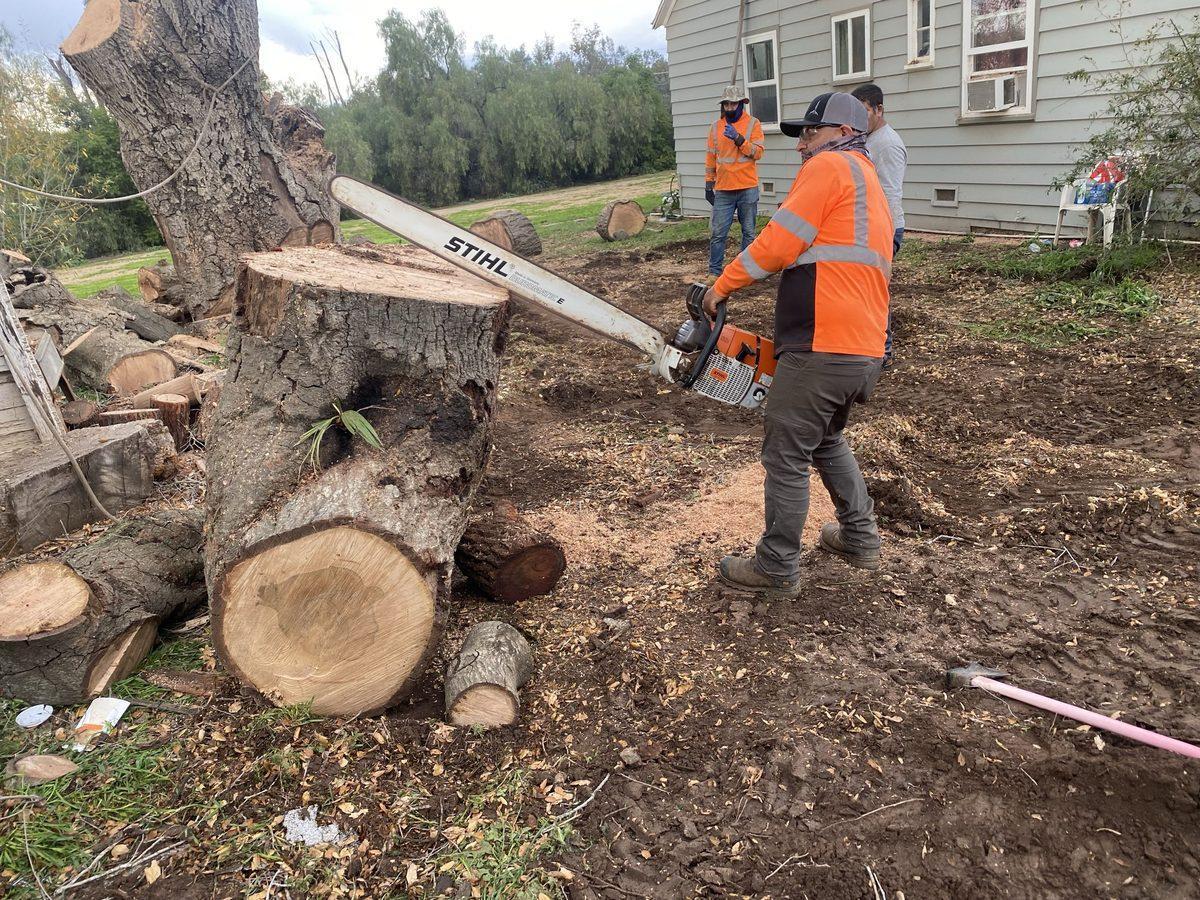
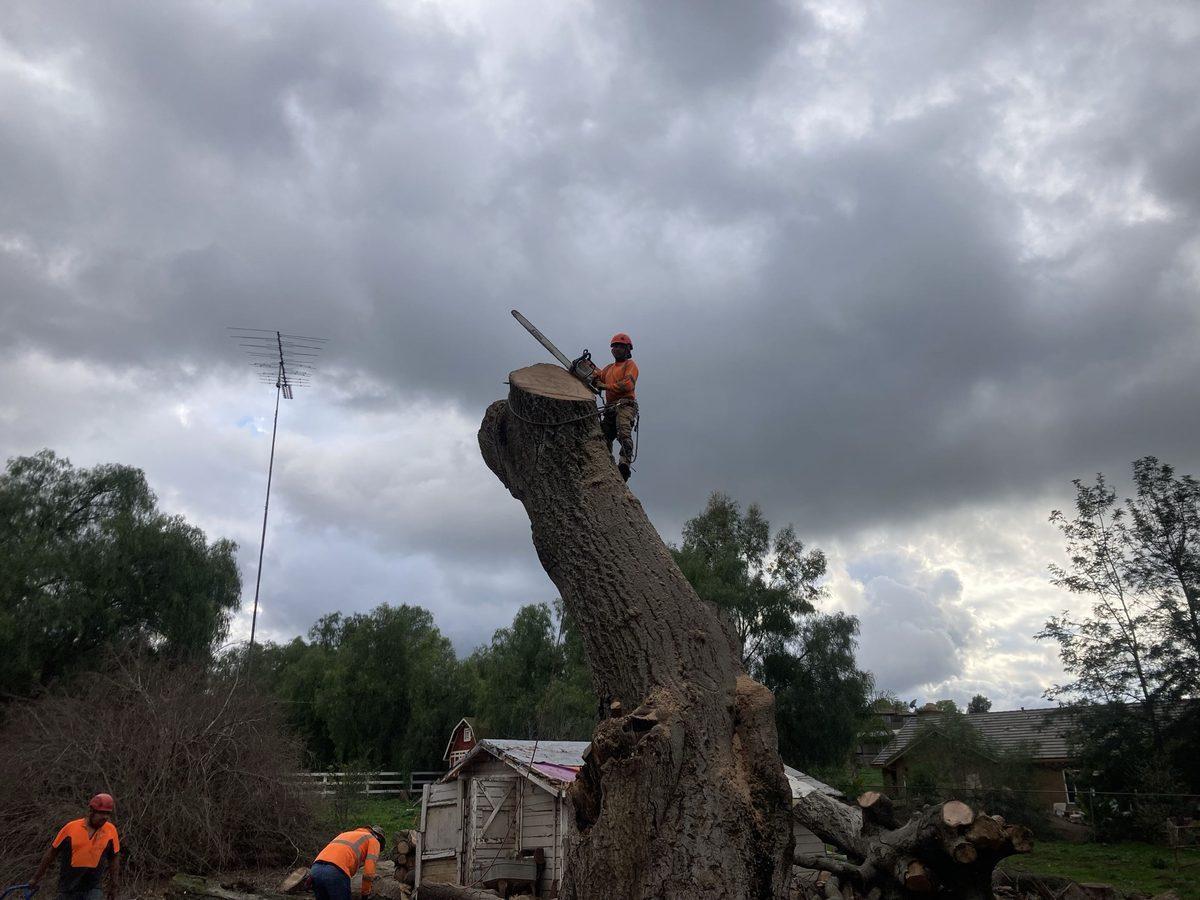
Stump grinding, on a real North County job.
Reclaiming the spot.
Backfill with soil for a lawn or sod, plant a new tree a few feet off the old root mass, and hold off on building over it unless you've had the roots fully removed — decaying roots settle over the years and can leave a low spot under a slab.
Once the stump is ground and the hole backfilled, the spot is yours again. The smart move depends on what you have in mind:
- Replant grass or lay sod — backfill with soil rather than raw grindings first, since fresh wood chips can tie up nitrogen as they break down and slow new grass.
- Plant a new tree nearby — yes, but not directly in the old root mass. The decaying roots make for poor, uneven soil, so set the new tree a few feet off and let the old roots break down.
- Pave or build — possible, with one honest caveat: the roots left underground keep decaying for years, and the soil can settle as they do. For a patio, slab, or anything structural, full root removal is usually the safer call so you don't get a low spot later.
We'll point out the right approach for your spot when we walk the yard with you — there's no upsell in steering you to the simpler, cheaper option when it's the one that fits.
Why we quote on site, not over the phone.
Stump grinding isn't one flat price — the number is driven by diameter, root spread, wood hardness, access, and how many stumps. That's why the estimate is free and on site, and you approve the price before any work starts.
No two stumps are the same job. What actually moves the number:
- Diameter — a narrow stump grinds out in minutes; a wide one is more wheel time.
- Root spread — surface roots radiating out from the stump add to the area we grind. Older eucalyptus and pepper trees are notorious for this.
- Access — an open front yard is easy; a locked or narrow backyard gate the grinder has to fit through, or one of Escondido's tiered hillside lots, is not.
- Wood hardness — a dense oak or a fibrous palm base takes longer to chew through than a soft, half-rotted stump.
- How many — a row of stumps in one visit is more efficient than a single one, and we'll reflect that in the quote.
- Cleanup & haul-away — part of the scope we quote up front, and the volume of grindings from a large stump is part of the day's work.
That's why the estimate is free and on site: we'd rather see the stump in person and give you a firm number than guess over the phone. You approve the price before any work starts.
From phone call to flush ground.
Free on-site estimate
We come look at the stump, the root spread, and the access before we quote. You approve the price before any work starts.
Grind below grade
The grinder takes the stump several inches below the surface so it's gone from view, won't sucker back, and the spot is usable again.
Cleanup, haul-away & backfill
Grindings hauled off or left as mulch at your call, the hole backfilled flush, the area raked clean.
Walk-through & sign-off
We walk the property with you before we leave so you can sign off in person that it's done right.
Pairs with a tree removal
Most stumps we grind are the ones left after a tree comes down. If you've still got the tree standing, it's usually cheapest to handle both in one visit — see tree removal in San Marcos & North County and we'll quote the removal and the stump together. Storm limb or leaning tree first? Start with emergency tree service.
5.0 stars, 97 reviews — and a crew that cleans up.
“Owner Daniel and his crew are the best at their landscaping craft. I have used them for irrigation repair, fence replacement, tree trimming and removal, and taking out old plants.”
Read more on our reviews page — 5.0 stars across 97 Google reviews.
Stump grinding across North County San Diego.
Based in San Marcos, we bring the grinder to you anywhere in North County — no street address on our end, we come to yours.
- San Marcos — our home base; call and we'll get you on the schedule fast.
- Escondido — sloped and tiered lots, older eucalyptus and pepper stumps with wide root spread.
- Vista & inland San Marcos — brushy parcels where fire-season clearing leaves stumps behind.
- Oceanside & Carlsbad — coastal yards where salt air and irrigation speed up stump decay and pests.
- Poway, Encinitas & Fallbrook — larger lots, avocado and citrus removals, estate palms.
Ready when you are.
Just had a tree taken down and want the stump gone too, or finally tackling the one that came with the house — we're open 24 hours across North County San Diego, and the estimate is free. Call and we'll get out to you.
Stump grinding & removal FAQ.
What's the difference between stump grinding and full stump removal?
Grinding chips the stump down to several inches below grade with a grinder, leaving the roots in the ground to decay naturally over time — it's the faster, less invasive, and more affordable option for most yards. Full removal means excavating the entire root ball out of the ground, which is more disruptive and more expensive but is sometimes needed before construction or where the roots are in the way of new footings. We'll tell you on site which one your situation actually calls for.
How deep do you grind a stump?
Standard is several inches below grade — deep enough that the stump is gone from view and you can lay sod or soil over it. If you're planning to replant a tree or lay a lawn, we grind deeper so there's clean planting depth. For anything you intend to build or pour over, deeper grinding or full root removal is the safer route, and we'll walk that through with you on site.
What happens to the grindings and mulch?
Grinding leaves a pile of wood grindings — essentially a coarse mulch. You can keep them to spread in beds, or we haul them off. Cleanup and haul-away are part of the scope we quote up front, so you're not left with a mound to deal with. We backfill the hole with grindings or clean soil so the spot sits flush.
What about the roots left in the ground?
After grinding, the roots stay underground and break down naturally over the following months and years. For most yards that's exactly what you want — no digging trenches across the lawn. If the roots themselves are the problem, such as lifting a driveway or in the way of a new footing, that's when full excavation makes sense instead.
Will the stump grow back or send up shoots?
Grinding the stump below grade removes the trunk tissue that most sprouting comes from, which stops the stubborn sucker regrowth many North County species — eucalyptus, pepper, some elms — push up when a stump is only cut flush. Occasionally a vigorous root can throw a shoot; if that happens it's easy to knock back, and grinding makes it far less likely than leaving a cut stump.
How much does stump grinding cost in San Marcos?
It depends on the stump's diameter, how far the roots spread, the hardness of the wood, the access to it, and how many stumps you have. A single small stump in an open San Marcos front yard is a quick job; a wide eucalyptus behind a locked Escondido gate is a different one. We give a free on-site estimate so we can see it before quoting, and you approve the price before any work starts.
How long does stump grinding take?
Most single stumps are a same-visit job — we set up, grind, and clean up in one trip. A wide hardwood, a cluster of stumps, or tight access adds time. When we give the estimate we'll tell you roughly how long yours will take so there are no surprises on the day.
Can I plant grass or a new tree where the stump was?
Grass and sod go in easily once the hole is backfilled with soil rather than raw grindings, since fresh wood chips can tie up nitrogen as they break down. You can plant a new tree nearby, but not directly in the old root mass — the decaying roots make for poor, uneven soil. We'll point out the best spot when we walk the yard with you.
Can I build or pave over a ground stump?
You can, but be honest with yourself about timing: the roots left underground keep decaying for years, and as they break down the soil can settle. For a patio, slab, or anything structural, full root removal is usually the safer call so you don't get a low spot later. We'll flag this on site so you can decide before anything is poured.
Are you licensed?
Artistic Solutions holds California contractor license CSLB #906384. It's a family-run crew — Daniel, Pablo and Elias — and you talk to the crew that does the work.
Do you grind the stump after a tree removal?
Yes. Stump grinding pairs naturally with a removal, and it's common to add it to the same job so the spot is reusable when we leave. We walk the property with you before we go so you can sign off in person. See tree removal if the tree is still standing.
Free on-site estimate. Fast response.
No pressure.
Call or send the form — we're open 24 hours and we'll get you on the schedule fast. Need the tree down too? We'll quote both.